
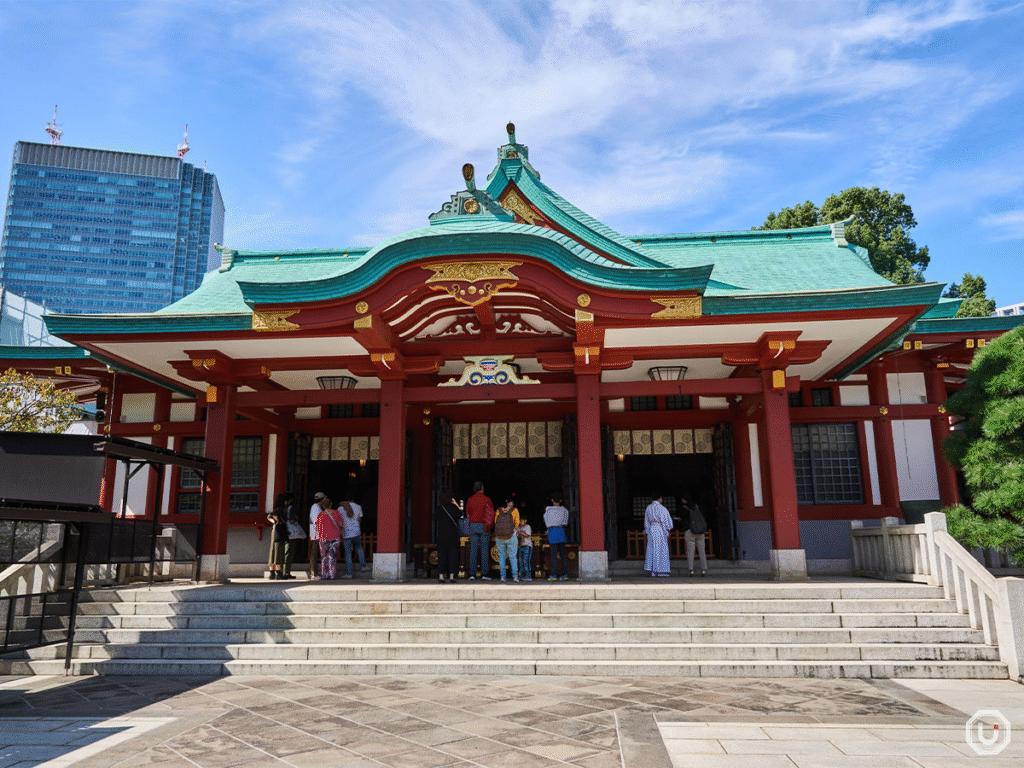
Hie Shrine stands as one of Tokyo’s foremost Shinto shrines, gracefully situated on a verdant hilltop between the dynamic Akasaka office district and the governmental heart of Nagatacho.1 This positioning allows the shrine to serve as a profound symbol of tranquility amidst the modern metropolis, presenting a striking contrast between ancient tradition and contemporary urban life.5 The shrine’s unique positioning on a verdant hill, surrounded by the towering structures of Tokyo’s bustling business and government districts, creates a striking visual and experiential paradox. This blend of ancient tranquility amidst modern urbanity serves as a microcosm of Japan itself, a nation that meticulously preserves its profound traditions while relentlessly innovating and embracing contemporary life. For visitors, stepping into Hie Shrine offers a distinct sensory transition, moving from the concrete dynamism of the city into a serene spiritual sanctuary. This juxtaposition underscores the shrine’s role not merely as a historical site but as a vital cultural anchor, providing a quiet refuge and a reminder of enduring heritage within a rapidly evolving metropolis.
Beyond its serene atmosphere, Hie Shrine is distinguished by its unique guardian deities – sacred monkeys, rather than the typical guardian dogs (komainu) found at most other shrines.1 This distinct feature, coupled with its vibrant annual festivals and a history deeply intertwined with Japan’s powerful shogunate, establishes Hie Shrine as a compelling and significant destination for any visitor to Tokyo. It is widely regarded as one of Tokyo’s notable “power spots”.8
Discover Hie Shrine (日枝神社)
An interactive guide to Tokyo’s serene spiritual heart, a tranquil oasis nestled amidst the bustling city.
Explore the Grounds
Hie Shrine’s layout is a journey in itself. Click on the highlighted points on the diagram below to learn about the key features of this sacred space, from its iconic gates to its unique guardian statues.
2. Main Hall (Haiden)
3. Guardian Monkey Statues
4. Main Gate (Sanno Torii)
Click a point to start
Select a numbered hotspot on the map to display information about that part of the shrine here.
A Resilient History
From its founding in the 15th century to its modern reconstruction, Hie Shrine has been central to Tokyo’s history. Click the dates on the timeline below to see key moments in its enduring legacy as a protector of the city.
1478
1607
1659
1868
1958
Select a date on the timeline to learn about a significant event in the shrine’s history.
The Great Sanno Matsuri
The Sanno Matsuri is one of Tokyo’s three great Shinto festivals. Its main event, the Jinko-sai parade, is a massive procession held in mid-June only in even-numbered years. The chart below visualizes the parade’s approximate timing and route.
Hover over the bars for details. The parade route is nearly 20km and takes all day.
Plan Your Visit
Ready to experience Hie Shrine? Here is all the essential information you need for a smooth and memorable visit, from getting there to opening hours.
📍 Location & Access
2-10-5 Nagatacho, Chiyoda-ku, Tokyo
- Tameike-Sanno Sta. (Ginza/Namboku Line): 3 min walk (Exit 7)
- Akasaka Sta. (Chiyoda Line): 3 min walk (Exit 2)
- Kokkai-gijidomae Sta. (Chiyoda Line): 5 min walk (Exit 5)
Note: Escalators are available for easy access up the hill.
⏰ Hours & Admission
Admission is Free
- Apr – Sep: 5:00 AM – 6:00 PM
- Oct – Mar: 6:00 AM – 5:00 PM
🐵 The Monkey Guardians
Instead of traditional lion-dogs, Hie Shrine is guarded by monkeys, believed to be divine messengers. Their name, “Masaru,” is a pun on the words for “victory” and “to ward off evil,” making them patrons of success and safe childbirth.
Echoes of Edo: A Rich History and Enduring Significance
The origins of Hie Shrine are rooted in the Kamakura period (1185–1333), with historical accounts largely crediting its formal establishment to the warlord Ota Dokan in 1478.2 Dokan initially founded the shrine with the specific purpose of protecting the back gate of Edo Castle.7
The shrine’s trajectory became intrinsically linked with the powerful Tokugawa clan. Upon assuming rule from Edo Castle, Shogun Tokugawa Ieyasu became a devoted patron of Hie Shrine.2 A pivotal moment occurred in 1607 when his son, Tokugawa Hidetada, ordered the shrine’s relocation from within the castle grounds to a site near the present-day National Theatre of Japan.3 This strategic move was significant as it granted common citizens of Edo unprecedented access to the shrine for worship, marking a notable shift in its accessibility beyond the elite.
Hie Shrine has demonstrated remarkable resilience throughout its history, having faced destruction multiple times. The devastating Great Fire of Meireki in 1657 ravaged much of Edo, including the shrine.3 However, its profound importance ensured a swift rebirth; in 1659, Shogun Ietsuna Tokugawa commanded its reconstruction at its current location.3 Tragically, the shrine suffered destruction once more during the intensive bombings of Tokyo in World War II, but it was meticulously rebuilt in 1958, resulting in the splendid structure visible today.3 The narrative of Hie Shrine’s repeated destruction and meticulous reconstruction, from devastating fires in the Edo period to the bombings of World War II, serves as a powerful testament to its profound and enduring significance. Each rebuilding effort, often initiated by powerful figures like the Tokugawa shoguns, underscores the shrine’s unwavering importance to the city and its people.
From 1868 onwards, particularly following the Meiji Restoration, Hie Shrine assumed the distinguished role of a guardian shrine for the Imperial Palace.2 This elevated status was further solidified between 1871 and 1946 when it was formally designated as one of the Kanpei-taisha, signifying its preeminent rank among government-supported shrines.3 Emperor Meiji himself visited the shrine to offer prayers for the nation’s peace and prosperity.3 Furthermore, its evolving role, from a protector of Edo Castle to a guardian shrine of the Imperial Palace after the Meiji Restoration, illustrates how its destiny has been intertwined with the very fabric of Japanese political and social history. The shrine’s continued prominence, despite facing numerous cataclysms, speaks volumes about its deep cultural and spiritual roots, reflecting the resilience and continuity of Japanese identity through centuries of change.
The Sacred Messengers: Unraveling the Monkey Motif
A distinctive characteristic of Hie Shrine is its unique protection by sacred monkey deities, a notable departure from the more common guardian lion-dogs (komainu) found at most Shinto shrines.1 These monkeys are revered as divine messengers of Oyamakui-no-kami (Sanno-no-kami), the shrine’s principal deity and the guardian of Mount Hiei.3
The monkey statues, particularly those referred to as “Masaru,” are imbued with profound symbolism.3 Phonetically, the word “Masaru” carries dual meanings: “to win” (勝る) and “to get rid of evil” (魔去る).7 Consequently, these sacred figures are believed to bestow blessings related to victory, protection from malevolent forces, and successful matchmaking.6 Visitors will observe statues depicting a husband monkey on the right and a wife with a baby on the left, symbolizing marital harmony and fertility.3 Even the wooden wish plates (ema) available at the shrine frequently feature the monkey motif.3 The color red, often associated with these monkeys, further signifies their protective role against disease and their patronage of fertility.12
Monkey worship has deep historical roots within Japanese culture, particularly linked to Taoist Kōshin rites and Tendai Shintō-Buddhism, which centered around Mount Hiei.12 Some scholars posit that the globally recognized “three wise monkeys” (speak no evil, hear no evil, see no evil) may have originated in connection with Mount Hiei and the sacred monkey of Hie Shrine.12 The monkey deity Sarugami is specifically recognized as Sannō’s messenger, serving as an intermediary between deities and humans.13 While the prominence of monkey worship reached its zenith during the Edo Era, its legacy persists today through various charms and ongoing rites.12 The distinctive presence of sacred monkey deities at Hie Shrine, a notable departure from the more common guardian lion-dogs found at most Shinto sites, reveals a rich tapestry of religious and cultural integration. These monkeys, known as divine messengers of the shrine’s main deity, Oyamakui-no-kami, carry deep symbolic weight. Their association with Mount Hiei, a historical center of Tendai Shintō-Buddhism, and their connection to Taoist Kōshin rites, illustrates a profound historical blending of indigenous Shinto beliefs with foreign religious influences. The various blessings attributed to these monkeys—ranging from victory and protection from evil to matchmaking and fertility—demonstrate how diverse spiritual needs have been addressed through this unique symbolism. This layered history of religious adaptation and evolving cultural meaning has forged a distinctive spiritual identity for Hie Shrine, one that continues to resonate with contemporary visitors seeking specific forms of spiritual support.
Architectural Splendor and Spiritual Pathways
Hie Shrine is celebrated for its classic Japanese architecture.5 One of its most iconic and frequently photographed features is the captivating tunnel formed by tightly packed, vivid red torii gates, particularly prominent at the west entrance.2 While perhaps not as globally renowned as those at Fushimi Inari in Kyoto, this tunnel offers a similarly striking visual experience and is a popular spot for photography.5 These gates are often donated by individuals and businesses as offerings for good fortune.14
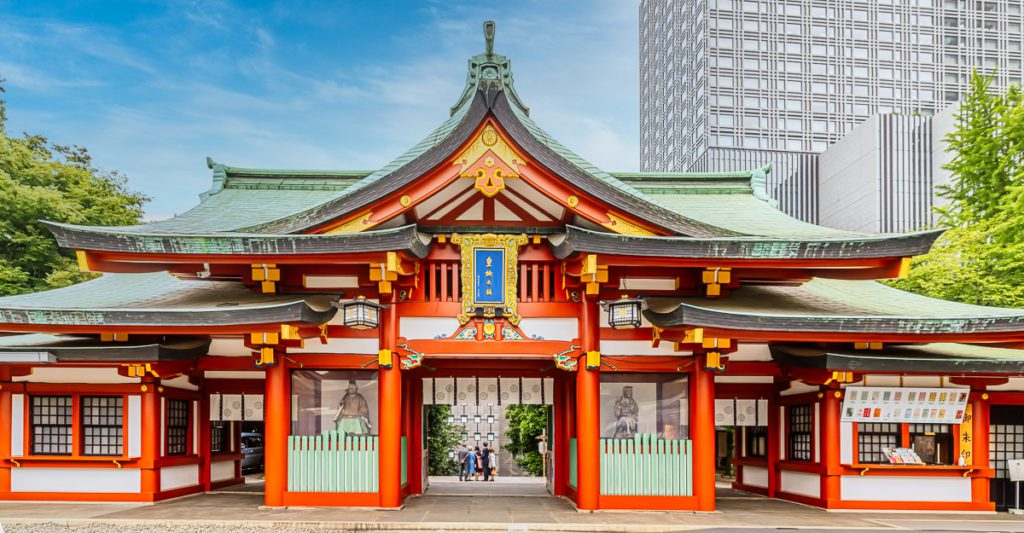
The shrine’s main torii gate at Sanno Bridge is uniquely shaped like a mountain with a distinctive triangular top.6 This “Gassho Torii” is believed to symbolize the union of Shintoism and Buddhism, specifically representing the womb world and the vajrayana world in Buddhist cosmology, thereby signifying unity. It is also said to subtly incorporate the character for “Sanno” within its design.7
The primary shrine pavilion, characterized by its beautiful bronze roof and vermilion color, exemplifies the Gongen-Zukuri architectural style.3 This complex style features multiple interconnected buildings, including the
Haiden (Worship Hall), where prayers are offered.5 The Haiden is typically connected to the
Honden (Sanctuary), where the kami (deities) are enshrined 15, often via a
Heiden (Offering Hall).15
Hie Shrine serves as a repository for significant cultural artifacts. Among its treasures is a National Treasure: an Itomaki-no-Tachi (long sword with detailed lacing) crafted by Ichimonji Norimune. Another notable item is a sword made by Bizen Osafune Nagamitsu, which once belonged to Emperor Meiji.1 The shrine also houses 14 Important Cultural Assets.9
Within the shrine precincts, particularly at Choto Hie Shrine, a large thatch ring is often erected.7 Passing through this ring, a ritual known as Chinowa Kuguri, is a purification rite intended to cleanse one’s sins and impurities accumulated over six months, and to invoke blessings for good health and protection from misfortune.7 Additionally, visitors may encounter Buddhist Jizo statues within the grounds, often adorned with red bibs and caps.9 Jizo is a revered Bodhisattva, recognized as the protector of children, travelers, and those in the underworld, believed to offer solace and blessings.9
The architectural layout of Hie Shrine is not merely aesthetically pleasing; it is meticulously designed to facilitate a profound spiritual journey for its visitors. The captivating ‘Senbon Torii’ tunnel, with its tightly packed vermilion gates, creates a pathway that physically and symbolically draws individuals deeper into the sacred precinct, suggesting an ascent towards heightened spiritual awareness. Similarly, the unique ‘Sanno Torii’ at the main entrance, with its distinctive mountain-like shape and triangular top, embodies a historical fusion of Shinto and Buddhist cosmological concepts, inviting contemplation on the unity of diverse spiritual realms. The presence of the Chinowa Kuguri, a ritual thatch ring, offers a direct, participatory means of purification, allowing visitors to actively engage in a centuries-old rite for well-being. These elements collectively demonstrate a sophisticated understanding of human spiritual engagement, translated into tangible architectural forms and ritualistic practices that foster a holistic cultural and religious immersion for all who visit.
A Calendar of Celebration: Festivals and Traditions
Hie Shrine is renowned for its vibrant calendar of annual events, with the Sanno Matsuri standing as its most prominent celebration.
The Grand Sanno Matsuri
The Sanno Matsuri is arguably Hie Shrine’s most famous event, recognized as one of the three great festivals of Edo (Tokyo), alongside Kyoto’s Gion Matsuri and Osaka’s Tenjin Matsuri.1 This is a profound cultural narrative for Tokyo, recognized as one of the three great festivals of the Edo period.
The Sanno Matsuri is an extensive celebration, spanning 11 days in mid-June.1 It encompasses over 20 distinct events 6, offering a diverse range of festivities for attendees. The highlight of the festival is the “Jinko-sai” or Grand Parade, which takes place specifically in
even-numbered years.3 This historically significant procession features three portable shrines (mikoshi) and hundreds of participants.3 It holds the unique distinction of being the
only festival that processes around the Imperial Palace, a powerful testament to the shrine’s historical connection and enduring reverence for the Imperial family.1 During the parade, the chief priest and a designated follower are granted the rare privilege of praying at the Imperial Palace for the well-being of the Imperial family.3 The parade route extends nearly 2 kilometers, commencing from Hie Shrine and proceeding through various key locations, including stops at Yasukuni Shrine, the Imperial Palace, and passing by Tokyo Station.17
Beyond the grand parade, the 11-day festival includes a rich array of traditional Japanese entertainment. This encompasses Shinto music and dance performances, powerful Sanno drum performances, and the Sanno Ondo and Folk Dance Festival, which is notably held earlier in the year than many other Japanese summer bon odori festivals. A charming parade of young children dressed as court pages also adds to the festive atmosphere.16 The sheer scale and historical continuity of this event, which necessitates substantial logistical and ceremonial coordination, reinforce the shrine’s unparalleled prestige and its deep connection to Japan’s national heritage. For those fortunate enough to witness it, the Sanno Matsuri offers an unparalleled opportunity to observe centuries of tradition brought vibrantly to life, providing a deeper appreciation for Tokyo’s rich historical tapestry and the enduring practices of Shinto.
It is important to clarify that the Sanno Matsuri at Hie Shrine in Tokyo is distinct from the Sanno Matsuri held at Hie-jinja Shrine in Takayama, Gifu Prefecture.18 While both are significant festivals associated with Hie Shrines, they are separate events in different geographical locations. This guide focuses exclusively on the Hie Shrine situated in Tokyo.
Other Notable Annual Events
Hie Shrine’s calendar extends beyond the Sanno Matsuri, offering other unique cultural experiences:
- Hiwatari Matsuri (Firewalking Festival): This dramatic autumn festival takes place on the 3rd Sunday of October. It is renowned for its firewalking ceremony, where participants bravely walk barefoot over hot coals. The festival also features a lively parade of portable shrines, traditional music, and dance performances.3
- Shichi-Go-San Festival: On November 15th, Hie Shrine participates in the nationwide Shichi-Go-San (Seven-Five-Three) coming-of-age festival. During this event, families bring young children (typically ages seven, five, and three) to the shrine to pray for their healthy growth and future well-being.3
- New Year’s Eve Bell Ringing: As part of a widespread Japanese tradition, Hie Shrine holds a midnight bell-ringing ceremony on New Year’s Eve. Visitors can participate by ringing the bell and offering a wish for the upcoming year.3
Traditional Japanese Weddings
On weekends, visitors to Hie Shrine might be fortunate enough to witness a traditional Japanese wedding procession.3 These ceremonies are a beautiful spectacle, often featuring the bride adorned in an exquisite kimono, providing another layer of cultural immersion for observers.
To provide a concise overview of the shrine’s major annual events, the following table summarizes key details:
| Festival Name | Approximate Date/Period | Key Highlights/Significance |
| Sanno Matsuri | Mid-June (11 days) | Grand Parade (biennial, even-numbered years, unique Imperial Palace procession); Shinto music & dance; Sanno drum performances; children’s parade. 1 |
| Hiwatari Matsuri | 3rd Sunday of October | Dramatic firewalking ceremony; parade of portable shrines; traditional music and dance. 3 |
| Shichi-Go-San Festival | November 15th | Children’s coming-of-age celebration; prayers for growth and well-being. 3 |
| New Year’s Eve Bell Ringing | Midnight on December 31st | Nationwide tradition; opportunity to ring the bell and make a wish for the new year. 3 |
For those interested in the specific route and timing of the Sanno Matsuri Grand Parade, the following table provides a general outline for even-numbered years:
| Approximate Time | Key Location/Landmark | Event/Activity |
| 7:45 AM | Hie Shrine | Parade Departure 17 |
| 8:45 AM | Yotsuya Station | Parade Progress 17 |
| 10:00 AM | Yasukuni Shrine | Parade Progress 17 |
| Until 12:15 PM | Imperial Palace | Half-hour stop for prayer ceremony 17 |
| After 12:15 PM | Past Tokyo Station | Parade Progress 17 |
| (Approx. 1 hour stop) | Nihonbashi Hie | Parade Stop 17 |
Planning Your Visit: Essential Information for Travelers
Hie Shrine’s central location makes it a convenient and accessible destination for travelers exploring Tokyo.
Location and Address
Hie Shrine is centrally located at 2-10-5 Nagata-cho, Chiyoda-ku, Tokyo-to.2 It is nestled on a hill between the prominent Akasaka and Nagatacho business districts.1
Getting There: Comprehensive Subway Access
The shrine boasts excellent accessibility via Tokyo’s extensive subway system 2, allowing for seamless integration into any Tokyo itinerary:
- Tameike-Sanno Station: A brief 3-minute walk from Exit 7, serving both the Tokyo Metro Namboku Line and Ginza Line.2
- Akasaka Station: Approximately a 3-minute walk from Exit 2 on the Tokyo Metro Chiyoda Line.7
- Kokkai-gijidomae Station: A 5-minute walk from Exit 5, also on the Tokyo Metro Chiyoda Line.7
- Akasaka Mitsuke Station: Located within a few minutes’ walk.14
For added convenience, particularly given its hilltop location, the shrine is equipped with escalators, ensuring an effortless ascent for all visitors.5
Opening Hours and Admission Fees
Hie Shrine is open daily, with seasonal variations in its operating hours:
- April to September: 5:00 am to 6:00 pm 3
- October to March: 6:00 am to 5:00 pm 3
Admission to Hie Shrine is free of charge.3
Best Times to Visit
- For Festivals: To experience the vibrant cultural celebrations, consider visiting in mid-June for the Sanno Matsuri, especially in even-numbered years to witness the Grand Parade.1 The Hiwatari Matsuri in October 3 and the Shichi-Go-San festival on November 15th 3 also offer unique cultural experiences.
- For Tranquility and Photography: An early morning visit is highly recommended to avoid larger crowds, particularly at the popular torii gate tunnel.14
- General Travel: The spring months of March to May are generally considered the most favorable time to visit Japan due to pleasant weather, though this period can also be a peak tourist season.20
On-site Facilities and Accessibility
The shrine is well-equipped to accommodate visitors, offering restrooms, designated non-smoking areas, and parking facilities.11 It is designed with accessibility in mind, featuring wheelchair ramps and multi-purpose toilets. Wheelchairs are available for loan, and facilities for diaper changing and breast-feeding are also provided.11
Nearby Attractions
Hie Shrine’s strategic central location allows for easy integration with visits to other prominent Tokyo attractions 11:
- Akasaka Sacas: A dynamic commercial complex housing the TBS TV station and various other facilities.6
- Tokyo Garden Terrace Kioicho: A modern commercial facility featuring lush greenery and expansive open spaces.6
- Toraya Akasaka Branch: The Akasaka branch of a venerable Japanese confectionery shop with a long history.6
- Roppongi Hills: A bustling district known for its significant international presence, diverse businesses, luxury retail, and cultural institutions.3
- The National Art Center: A prominent exhibition venue celebrated for its spectacular architecture.3
- Imperial Palace: The official residence of the Emperor’s family, with its East Garden open to the public.3
- Meiji Shrine, Kanda Shrine: Other significant and historically rich Shinto shrines within Tokyo.3
- Akihabara: Known as “Electric Town,” a hub for electronic gadgets and pop culture.3
- Shibuya, Tokyo Tower, Ginza, Tokyo Station: Other major Tokyo landmarks are all conveniently accessible by train.8
To provide a quick reference for planning, the following table summarizes key information about Hie Shrine:
| Feature | Detail |
| Address | 2-10-5 Nagata-cho, Chiyoda-ku, Tokyo-to 2 |
| Main Deity | Oyamakui-no-kami (Sanno-no-kami) 3 |
| Guardian Symbol | Sacred Monkeys (Masaru) 1 |
| Architectural Style | Gongen-Zukuri 3 |
| Founder | Ota Dokan 2 |
| Date Established | 1478 (origins date to Kamakura period) 2 |
| Official Website | www.hiejinja.net/jinja/english/index.html 10 |
| Opening Hours (Seasonal) | Apr-Sep: 5:00-18:00; Oct-Mar: 6:00-17:00 3 |
| Admission Fee | Free 3 |
| Primary Blessings | Love fulfillment, business success, prosperity, victory, protection from evil, matchmaking, marital harmony, fertility 6 |
| Notable Features | Senbon Torii (Thousand Torii Gates), Sanno Torii (Gassho Torii), Monkey statues, National Treasures, Chinowa Kuguri, Escalator access 2 |
| Accessibility | Wheelchair accessible (ramps, multi-purpose toilets, loan), diaper changing, breast feeding room 11 |
Tips for a Memorable Hie Shrine Experience
To maximize the experience at Hie Shrine and during a broader visit to Tokyo, several practical considerations are beneficial:
Photography Insights
Hie Shrine presents abundant photographic opportunities. Visitors are encouraged to capture the distinct monkey statues, which are unique to this shrine.5 The famous “Senbon Torii” tunnel, particularly from either end of the steep staircase at the West Entrance, offers a striking visual for photography.5 Additionally, the compelling contrast of the traditional shrine architecture set against the backdrop of modern Tokyo skyscrapers provides a unique visual narrative.5 For optimal photographic conditions and to avoid crowds, an early morning visit is highly recommended.14
General Travel Advice for Tokyo
- Connectivity: Securing a pocket Wi-Fi device or an eSIM in advance is advisable to ensure immediate data access upon arrival in Japan.20
- Navigation: Utilizing mobile applications such as Google Maps is highly beneficial for navigating Tokyo’s extensive and efficient public transportation system.20
- Comfortable Footwear: Given that exploring Japan often involves a significant amount of walking, wearing comfortable shoes is essential for an enjoyable experience.20
- Sustainability Practices: Bringing a reusable tumbler is encouraged to reduce the need for purchasing bottled water. Furthermore, carrying a small plastic or paper bag for personal garbage is practical, as public trash cans are not commonly found in Japan.20
- Japan Rail Pass: For travelers planning extensive travel across multiple cities in Japan, considering the purchase of a Japan Rail Pass (JR Pass) in advance can offer convenience and cost efficiency.20
- Luggage Management: For multi-city itineraries, utilizing luggage delivery services can significantly enhance convenience by alleviating the burden of transporting heavy bags between locations.20
Conclusion
Hie Shrine stands as a quintessential representation of Tokyo’s rich cultural and spiritual heritage, seamlessly blending ancient tradition with the dynamism of a modern metropolis. Its history, deeply interwoven with the Tokugawa shogunate and its role as a guardian of the Imperial Palace, underscores its profound national significance. The shrine’s unique embrace of sacred monkey deities, imbued with layered symbolism related to victory, fertility, and protection, offers a distinctive spiritual narrative that sets it apart.
The architectural elements, from the captivating Senbon Torii to the symbolic Sanno Torii, are not merely structures but integral components of a carefully curated spiritual journey, designed to guide and purify visitors. Furthermore, the annual Sanno Matsuri, particularly its biennial Grand Parade, serves as a living historical performance, reinforcing the shrine’s enduring prestige and its unique connection to the Imperial family. This festival, along with other seasonal events, provides unparalleled opportunities for cultural immersion.
For travelers, Hie Shrine offers not just a site of historical and religious importance but a serene urban oasis, easily accessible and equipped with modern facilities. Its compelling blend of unique cultural practices, architectural splendor, and vibrant traditions makes it an indispensable destination for anyone seeking to understand the deeper layers of Tokyo’s identity.
Works cited
- Hie Shrine: Everything You Need Before Visiting, accessed July 6, 2025, https://www.klook.com/en-US/destination/p50139517-hie-shrine/
- Hie-jinja Shrine | Travel Japan – Japan National Tourism Organization (Official Site), accessed July 6, 2025, https://www.japan.travel/en/spot/1732/
- Explore Hie Shrine – Tokyo Travel Guide | japan365days, accessed July 6, 2025, https://www.japan365days.com/tokyo_hie_shrine.php
- www.japan365days.com, accessed July 6, 2025, https://www.japan365days.com/tokyo_hie_shrine.php#:~:text=The%20Hie%20Shinto%20Shrine%20(Hie,(Shiga%20prefecture)%20near%20Kyoto.
- Hie Shrine Photo Guide – Tokyo in Pics, accessed July 6, 2025, https://tokyo-in-pics.com/hie-shrine/
- Hie Shrine – Must-See, Access, Hours & Price | GOOD LUCK TRIP, accessed July 6, 2025, https://www.gltjp.com/en/directory/item/10133/
- Hie-jinja Shrine and Sanno Inari Shrine [Tokyo] | Tour of Japanese …, accessed July 6, 2025, https://japan-shrine.info/en/hie-jinja-shrine/
- Hie-Shrine | Henn na Hotel Tokyo Akasaka | Official Website, accessed July 6, 2025, https://tokyo-akasaka.hennnahotel.com/point-of-interest/hie-shrine/
- Hie-jinja Shrine | Onehourtourist, accessed July 6, 2025, https://onehourtourist.com/articles/hie-jinja-shrine/
- Hie Shrine – Wikipedia, accessed July 6, 2025, https://en.wikipedia.org/wiki/Hie_Shrine
- Hie Jinja | The Official Tokyo Travel Guide, GO TOKYO, accessed July 6, 2025, https://www.gotokyo.org/en/spot/343/index.html
- Monkeys | Traditional Kyoto, accessed July 6, 2025, https://traditionalkyoto.com/culture/monkeys/
- Monkeys in Japanese culture – Wikipedia, accessed July 6, 2025, https://en.wikipedia.org/wiki/Monkeys_in_Japanese_culture
- Top 3 Torii Gate Tunnel Photo Spots in…Tokyo! – Japan Rail Pass, accessed July 6, 2025, https://www.jrpass.com/blog/top-3-torii-gate-tunnel-photo-spots-in-tokyo
- Shinto architecture – Wikipedia, accessed July 6, 2025, https://en.wikipedia.org/wiki/Shinto_architecture
- Sanno Festival (Sanno Matsuri) | The Official Tokyo Travel Guide, GO TOKYO, accessed July 6, 2025, https://www.gotokyo.org/en/spot/ev048/index.html
- Sanno Matsuri 2026 – June Events in Tokyo – Japan Travel, accessed July 6, 2025, https://en.japantravel.com/tokyo/sanno-matsuri-grand-parade/13479
- Takayama Festival – Japan Guide, accessed July 6, 2025, https://www.japan-guide.com/e/e5909.html
- The Sanno Matsuri Festival at Hie-jinja Shrine in Takayama – ROPPONGI, accessed July 6, 2025, https://roppongi.fr/en/sanno-matsuri-at-hie-jinja-shrine-in-takayama/
Hie Shrine | Secluded Shrine in the Middle of Tokyo, Japan – King Tolentino, accessed July 6, 2025, https://www.kingtolentino.com/blog/hie-shrine